Although yesterday's budget is perceived to be all doom and gloom, there was a ray of hope: the government announced an additional investment of £5 million to support voluntary sector early years services, which of course includes out of school care.
Irene Audain, SOSCN Chief Executive said, " I welcome the announcement of a further investment of £5 million to support third sector organisations delivering early years services, although, I await the finer details of this.
Of the 1000+ out of school care services in Scotland over half are third sector organisations,many of whom are struggling in this financial climate, without statutory duties on councils to support them; either in direct funding or infrastructure support.
In terms of further capital investment in the schools estate, this may be a golden opportunity to ensure that new or refurbished schools have plans built in to ensure that there is(free or low costs) space for the delivery of the complementary service school age childcare provides for children, parents, school and community.
School age childcare services are doubly important in tough financial times,first as a lifeline for parents struggling to stay employed, and we also need to think about supporting more places, for vulnerable children, affected by poverty or disability, as the wider UK welfare cuts may impact heavily on their families."
Thursday, 18 November 2010

Wednesday, 20 October 2010
SPENDING REVIEW MAKES CHILDREN PAY TODAY TO PROTECT WEALTHY TOMORROW
SOSCN is a member of the Campaign to END CHILD POVERTY and fully supports the comments below.
SPENDING REVIEW MAKES CHILDREN PAY TODAY TO PROTECT WEALTHY TOMORROW
20 October 2010
Commenting on the Spending Review, Rhian Beynon, spokesperson for the End Child Poverty Campaign of more than 150 member organisations, said:
"The compensating measures don't go nearly far enough to stop this being a dark day for any family struggling to stay out of poverty, or deep in it already and fearing things will get worse still. With a Child Tax Credit increase worth just 58p more a week next year, the poorest children have less than the price of a loaf of bread to compensate.
"The cuts to benefits now total over £18 billion, with the main part focussed on cuts to support for families. Cuts to support for childcare costs and a freeze for Sure Start services will harm families too and make it harder for them to get and keep paid work.
"We accept the importance of reducing the deficit, but we don't accept the approach chosen. Claims that the wealthiest carry the biggest burden and measured child poverty will not increase did not stand up to independent scrutiny in the emergency budget and we do not accept the claims to survive scrutiny this time either .The Spending Review will almost certainly increase child poverty and increase the economic costs faced by any society with high levels of poverty, inequality and social exclusion.
"The promise of fairness has not been met. While unprecedented cuts to essential support and services are rushed through, the review fails the challenge of saving the tens of billions lost on tax evasion and does not ask the wealthiest to make a full and fair tax contribution. A fairer ratio of cuts to tax rises along with a reduction timetable recognising the risks to jobs and growth in our fragile recovering economy would have met the fairness test. The resulting message is: 'children must pay today to protect the wealthy tomorrow'."
SPENDING REVIEW MAKES CHILDREN PAY TODAY TO PROTECT WEALTHY TOMORROW
20 October 2010
Commenting on the Spending Review, Rhian Beynon, spokesperson for the End Child Poverty Campaign of more than 150 member organisations, said:
"The compensating measures don't go nearly far enough to stop this being a dark day for any family struggling to stay out of poverty, or deep in it already and fearing things will get worse still. With a Child Tax Credit increase worth just 58p more a week next year, the poorest children have less than the price of a loaf of bread to compensate.
"The cuts to benefits now total over £18 billion, with the main part focussed on cuts to support for families. Cuts to support for childcare costs and a freeze for Sure Start services will harm families too and make it harder for them to get and keep paid work.
"We accept the importance of reducing the deficit, but we don't accept the approach chosen. Claims that the wealthiest carry the biggest burden and measured child poverty will not increase did not stand up to independent scrutiny in the emergency budget and we do not accept the claims to survive scrutiny this time either .The Spending Review will almost certainly increase child poverty and increase the economic costs faced by any society with high levels of poverty, inequality and social exclusion.
"The promise of fairness has not been met. While unprecedented cuts to essential support and services are rushed through, the review fails the challenge of saving the tens of billions lost on tax evasion and does not ask the wealthiest to make a full and fair tax contribution. A fairer ratio of cuts to tax rises along with a reduction timetable recognising the risks to jobs and growth in our fragile recovering economy would have met the fairness test. The resulting message is: 'children must pay today to protect the wealthy tomorrow'."
Wednesday, 13 October 2010

MAKING SPACE 2010 – OUT OF SCHOOL CARE CLUB WINS COMMENDATION IN INTERNATIONAL ARCHITECTURAL AWARD
Photo – Irene Audain – CE, SOSCN and member of the Making Space Advisory Panel; Laurence Williams, Director, Hyndland ASC; Jason Brown, Architect for the entry; Fiona Ansdell, Manager, Hyndland ASC; Mike Russell, MSP, Cabinet Secretary for Education and Lifelong Learning and Zia Hug, Structural Engineer for the entry. (Photo: A Mackin)
MAKING SPACE 2010
With the support of the Scottish Government, Architecture+Design Scotland, the OECD Centre for Effective Learning Environments, Eurochild, and Children in Europe, this award and the international conference showcased great examples of well designed places for young people. See Children In Scotland Press release at the end of this blog.
Hyndland After School Club (Commended Award - winner for Scotland)
Hyndland after school club are in the news again, as they took the time to enter the MAKING SPACE 2010 Architectural Award. Imagine their surprise when they realised they had won an award in a competition which had entries from a wide range of countries and of a very high standard. SOSCN is doubly pleased as this is the first time an out of school care has won an award in this competition.
Congratulations to all at Hyndland After School Care Club, Jason Brown, the architect from Abbozzo and Zia Hug, the structural engineer from Hug and Santiago, for their Commended Award in Making Space 2010 on Thursday 7th October 2010. This award is for the innovative, bright and colourful mezzanine floors and constructions they worked hard to create for the “Aftie”. The Cabinet Minister for Education and Lifelong Learning; Mike Russell presented the awards and is seen in the above photo, congratulating the group.
It is clear that the children were involved in the project and the resulting low cost, bright and imaginative additional space to play and work are appreciated by all of the club users. SOSCN is delighted that a school age childcare service has won an award in this competition as we are committed to supporting environmentally and socially supportive spaces for children, and, of course, we know the challenges every school age service faces in trying to achieve this.
See photos here of the Hyndland Mezzanine designs:
Hyndland Photos 1
Hyndland Photos 2
For more information about the “Aftie”, as it is affectionately known by the children, go to: www.hyndlandasc.org.uk
Overall Winner
Entrant: TYIN Tegnestue, Norway
SOSCN also congratulates all of the entries and to all the partners involved in Making Space 2010, as well as Children in Scotland for organising the award and conference. All of the shortlisted entries were fantastic and the overall winner was absolutely outstanding. Please use this link below to see the library, and children’s houses they built in Thailand.
www.tyintegnestue.no
Name of Building/Space: Library and two residential houses
Country: Thailand
Type of Building/Space: Library and two residential houses
Description: TYIN Tegnestue is a non-profit organisation working Humanitarian aid through architecture. TYIN is run by five architect students from NTNU and the projects are financed by more than 60 Norwegian companies, as well as private contributions.
Hazelwood School (Shortlisted)
Irene Audain visited Hazelwood School on Thursday 7th October, this was one of the 25 shortlisted entries and has already won numerous other awards.
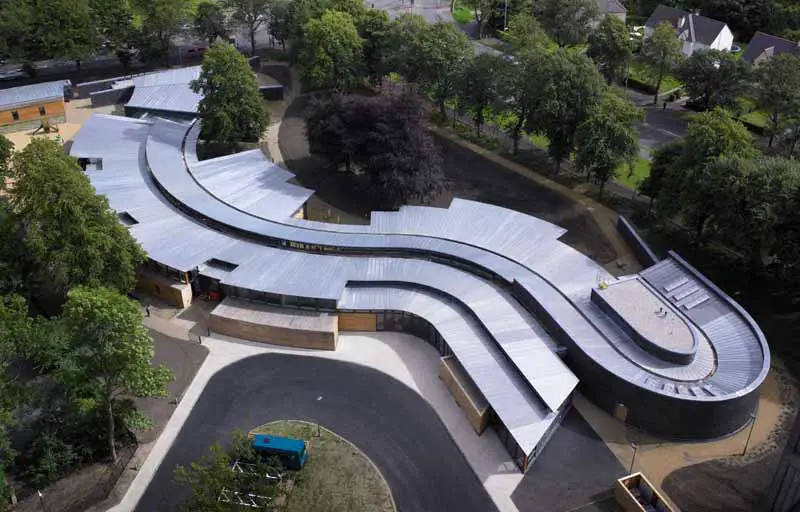
This school caters for children and young people with multiple sensory impairments and highly complex needs. The design of the building, including walls, floors, lighting, ventilation and outside classroom and leisure space is geared to developing independence and supporting transitional skills. It is a curving building, with a wide, welcoming, open, bright, meeting space at the reception area, but it also gives a sense of enclosure and safety.
Clever use is made of natural light, timber and slate materials which will age and blend into the surrounding landscape of trees and semi wild greenery. While I was there, leaves were blowing off the trees and landing on part of the glass roof (at one end of the building), creating a direct awareness of the weather and the season, not always available in institutional buildings.
Every classroom ensured privacy for the pupils and staff, with natural walls in strong blocks of colours built up just beyond adult height; but with cutaway windows, high glass panels and high windows to ensure natural light. Each room had its own doorway to an outside working and relaxing area (thus linking inside/outside as the children’s learning and also “breathing" space).
Grooves in the inside wall of natural wood, and on the floor, all along the length of the building, are used by visually impaired children to track their space, and grooves in the floor entrance areas to classrooms also provided additional signs to aid identification of the right room. From the public corridor space to the quieter classroom spaces there are acoustical changes, created with lowered ceilings; this also helps in identifying a transition from one type of space to another and in providing clearer acoustics for children with hearing and sight loss.
Children and young people who attend Hazelwood School are there to learn holistic life skills; thus combining attributes of both what we would see as formal school and informal out of school care for children and young people. There is also a large emphasis on the community being involved with the school and the children with the community, such as using the nearby park, gym and sports facilities. This is again part of the whole independence and integration ethos of the school; to help each child or young person develop to the maximum of their abilities in an environment which adds to the quality of their lives.
Hazelwood Photo
Hazelwood School
CHILDREN IN SCOTLAND PRESS RELEASE 12/10/2010
(We (SOSCN) have emphasised in italics below comments about Hyndland.)
International design award and event celebrates space for young people
Scotland’s role in promoting architectural advancement was spotlighted at an international conference and awards ceremony in Edinburgh last night, marking the glittering finale to Childrenin Scotland’s year-long ‘Making Space 2010’ programme, championing innovative architecture and the creation of inspiring spaces for young people and communities. A highlight of the two-day event was the official dinner, where the winner of the Making Space 2010 Architecture Award was announced by Cabinet Secretary for Education and Lifelong Learning, Michael Russell.
The overall award was won by Min Buri Old Market Library, Soe Ker Tie House and Safe Haven Orphanage Thailand, designed by architects TYIN Tegnestue, Norway. The project was commended for its ‘completely child-centred approach’, which the judges felt ‘met the needs of a child within a social and cultural context’, while also displaying ‘architectural qualities [which] are outstanding’. The building was felt to show an ‘innovative and imaginative use of simple materials’ and focused attention on the value of community and intergenerational working, as well as on the power of education. Summing up their decision, the judging team said: “[The project] shows innovative ways of giving the inhabitants some basic services but also drives home the importance that education plays, and provides a focus for the community that is hoped will build passion in the neighbourhood that eventually can contribute to a positive development in the area.”
With a shortlist which also included a revolutionary ‘Transportable Classroom’ from Mali, ‘The Puckelball Pitch’, an interactive art project from Sweden which represents the frequently unfair and unequal ‘playground of life’, and innovative entries from Scotland, all eyes were on Edinburgh as the design agenda for the future was unveiled.
Other commended entries included Punkaharju Day Care Centre, Punkaharju, Finland, which the judges praised for its ‘simple, clear and sensitive design’, which, crucially, is ‘adaptable to the age of the pupils’. The Centre is also sensitive to its environment, noted for its ‘fit to landscape andenvironment’. Overall it was viewed as ‘simple, responsive, flexible, well-integrated, small-scale,child-friendly and sustainable’.
The Scottish award was won by Hyndland After School Club, Partick, Glasgow, which provides out of school care for children aged between 5 and 12 years, allowing thier parents to work without facing issues of childcare. Their premises are located within Hyndland Primary school grounds, utilising a refurbished dining hall. which allows for greater flexibiity in their service. This entry impressed with its "low cost imaginative and innovative use of old premises, and a very ordinary space", which should remind cash strapped Councils that developing curricular innovation and supporting workforce change in Scotland does not require large scale spending.
The conference itself brought together a range of international experts to examine issues related to children and space, from aspects of how children and young people relate to their environment and its impact on their development, to what makes a good learning environment and what elements need special focus in the future.
Chaired by Seona Reid, Director, Glasgow School of Art, the two-day event also heard from Scottish architects including Sam Cassels, Design Advisor (Schools), Architecture+DesignScotland, alongside other UK and international design experts, and included an opportunity for delegates to join study visits to inspiring and innovative new buildings and projects in Central Scotland and to hear from those directly involved in their design and planning.Michael Russell is in no doubt that Scotland is uniquely placed to host such a design showcase.
Speaking ahead of the event, the Cabinet Secretary said: “Making Space 2010 has offered an arena for us to share ideas the future of Scotland’s schools and to gather examples of the best school design from around the world; it has made an important contribution to ensuring Scotland leads the field in innovative and progressive school design.”
For further information on the conference, about the award winners, or for images, contact Lynn Gilmour: lgilmour@childreninscotland.org.uk.
Thursday, 23 September 2010
The Danish Experience
Two SOSCN members from Glasgow, Beverley Anderson (Broomhill Out of School Care Association) and Fiona Ansdell (Hyndland After School Club), graduated this summer from the University of Glasgow with the BA in Childhood Practice. As part of the course, Beverley and Fiona chose to undertake a practice placement visit to Holstebro, Denmark in late 2009 to see the delivery of after school care services and kindergartens.
Within Denmark out of school care services are referred to as “fritidshjem” (free time home) and staffed by pedagogues (degree-level qualified staff in Pedagogy [social education]). The Danish government has a duty to provide high-quality childcare; hence a high level of financial support and other resources.
For a number of years, SOSCN has organised placements for Danish Pedagogy students, some of whom have worked within Hyndland. If you would like to register your interest in having a Danish pedagogue student, please contact SOSCN.
Reflection on Danish Out of School Care Services
Beverley Anderson
Fiona Ansdell
In Denmark day-care facilities must be available to all children, and the government has assumed the cost of subsidizing a high-quality, comprehensive child-care system for infants and children from 6 months to 7 years of age, as well as an extensive after-school child-care system for school-age children.
Children requiring after school care (which can be around 90% in some areas) will go to a public after-school centre for 6-9 year-old children or a school based recreation scheme for the same age group. The local authorities must also provide the necessary club and other socio-educational leisure time facilities for children and young people from the age of 10. The local authorities are required to draw up aims and frameworks for club activities, in order to provide a variety of good stimulating leisure-time facilities. Children participate in, amongst other things, woodworking, building fires, baking bread and pizzas over open fires and looking after animals.

All facilities have a manager and deputy-manager, both of whom must be qualified pedagogues. The establishments we visited also had unqualified assistants. The staff do not have to worry about cleaning or cooking or providing snacks: chefs and cleaners are employed, and in most after school clubs parents provide food.
We found, when visiting the various after school clubs in Denmark, that the take up was considerable as schools finish at lunch time and parents typically work until four or 5pm. Furthermore, women make up nearly half the total workforce – the participation rate for women of working age is 87.5%.
Our first impression was one of amazement. The premises, outdoor areas and equipment were all far superior to what we are used to. The acceptance of after school provision being part of the education system, and the after school workers being part of the education team was very evident as was the importance of the social education provided.
At the first after school club we visited the manager shared an office with the deputy head of school. Pedagogues and teachers had joint weekly meetings and shared individual daily ‘hand-over’ meetings. We found this to be the norm.
Services are statutory and largely government funded. They are under the jurisdiction of the Ministry of Social Affairs which puts an equal responsibility on educational, social and care purposes. Parents pay approximately 30% of the costs directly to the government thus leaving the services free from the burden of fee collection. Their operational budget (from the government) was more than adequate and all the services we visited had a good range of quality equipment, resources and furnishings. All the establishments we visited were either purpose built or part of a school designed for children, with large, low windows, lots of natural light and large natural outdoor spaces. The interiors were designed to be homely with traditional Scandinavian furnishings unlike most of our schools with institutional furniture devoid of any soft furnishings. The after school cares (fritidshjem) certainly lived up to their name.

The high level of government funding results in play areas resembling adventure playgrounds with a vast array of go-karts, bikes, rope swings, climbing frames, pizza ovens, fire pits and tools for indoors and out use. We noted there was little discord between the children as they had an abundance of space and equipment, and little intervention was required by staff. Although many of the areas were un-fenced there seemed to be an ethos of trust which the pedagogues told us was established from a very early age. We witnessed this ourselves: the children could be out of sight in the playgrounds, in rooms on their own and still have access to knives, fires and tools. They climbed trees and raced in go-karts with limited supervision.

Comparisons between Glasgow and Holstebro are difficult as most of the establishments we visited were in fairly rural settings. One particular service, The Garden, caters for 3 – 10 year olds and is located in the countryside close to Holstebro with a garden, orchard, small farm, aviary and private forest cabin. Similarly to many Scottish out of school care services, it is run by a voluntary management committee. The parents’ input, which included physical help and donations of money, enabled the building of play houses, sheds, cart tracks and outdoor classrooms.
Visiting the Garden allowed us to examine the differences between local authority and independently run institutions. The children learned about all aspects of raising animals both for food and as pets. Animals were killed and cooked on the farm and eaten by the children, as were the eggs and fruits harvested from the orchard.
We wondered how many of our children would stay indoors playing computer games if the school playground had an all-equipped go-kart track, flying fox or BMX track?
In conclusion, we feel very fortunate in having been able to undertake our practice placement in Denmark. It was a rich and unforgettable experience which, although frustrating in that out of school care in Scotland does not receive the status and respect it has in Denmark, it nevertheless has left us feeling proud of what we have achieved in our settings and will inspire us to continue to raise our standards and continue to explore pedagogical practices.


Within Denmark out of school care services are referred to as “fritidshjem” (free time home) and staffed by pedagogues (degree-level qualified staff in Pedagogy [social education]). The Danish government has a duty to provide high-quality childcare; hence a high level of financial support and other resources.
For a number of years, SOSCN has organised placements for Danish Pedagogy students, some of whom have worked within Hyndland. If you would like to register your interest in having a Danish pedagogue student, please contact SOSCN.
Reflection on Danish Out of School Care Services
Beverley Anderson
Fiona Ansdell
In Denmark day-care facilities must be available to all children, and the government has assumed the cost of subsidizing a high-quality, comprehensive child-care system for infants and children from 6 months to 7 years of age, as well as an extensive after-school child-care system for school-age children.
Children requiring after school care (which can be around 90% in some areas) will go to a public after-school centre for 6-9 year-old children or a school based recreation scheme for the same age group. The local authorities must also provide the necessary club and other socio-educational leisure time facilities for children and young people from the age of 10. The local authorities are required to draw up aims and frameworks for club activities, in order to provide a variety of good stimulating leisure-time facilities. Children participate in, amongst other things, woodworking, building fires, baking bread and pizzas over open fires and looking after animals.

All facilities have a manager and deputy-manager, both of whom must be qualified pedagogues. The establishments we visited also had unqualified assistants. The staff do not have to worry about cleaning or cooking or providing snacks: chefs and cleaners are employed, and in most after school clubs parents provide food.
We found, when visiting the various after school clubs in Denmark, that the take up was considerable as schools finish at lunch time and parents typically work until four or 5pm. Furthermore, women make up nearly half the total workforce – the participation rate for women of working age is 87.5%.
Our first impression was one of amazement. The premises, outdoor areas and equipment were all far superior to what we are used to. The acceptance of after school provision being part of the education system, and the after school workers being part of the education team was very evident as was the importance of the social education provided.
At the first after school club we visited the manager shared an office with the deputy head of school. Pedagogues and teachers had joint weekly meetings and shared individual daily ‘hand-over’ meetings. We found this to be the norm.
Services are statutory and largely government funded. They are under the jurisdiction of the Ministry of Social Affairs which puts an equal responsibility on educational, social and care purposes. Parents pay approximately 30% of the costs directly to the government thus leaving the services free from the burden of fee collection. Their operational budget (from the government) was more than adequate and all the services we visited had a good range of quality equipment, resources and furnishings. All the establishments we visited were either purpose built or part of a school designed for children, with large, low windows, lots of natural light and large natural outdoor spaces. The interiors were designed to be homely with traditional Scandinavian furnishings unlike most of our schools with institutional furniture devoid of any soft furnishings. The after school cares (fritidshjem) certainly lived up to their name.

The high level of government funding results in play areas resembling adventure playgrounds with a vast array of go-karts, bikes, rope swings, climbing frames, pizza ovens, fire pits and tools for indoors and out use. We noted there was little discord between the children as they had an abundance of space and equipment, and little intervention was required by staff. Although many of the areas were un-fenced there seemed to be an ethos of trust which the pedagogues told us was established from a very early age. We witnessed this ourselves: the children could be out of sight in the playgrounds, in rooms on their own and still have access to knives, fires and tools. They climbed trees and raced in go-karts with limited supervision.

Comparisons between Glasgow and Holstebro are difficult as most of the establishments we visited were in fairly rural settings. One particular service, The Garden, caters for 3 – 10 year olds and is located in the countryside close to Holstebro with a garden, orchard, small farm, aviary and private forest cabin. Similarly to many Scottish out of school care services, it is run by a voluntary management committee. The parents’ input, which included physical help and donations of money, enabled the building of play houses, sheds, cart tracks and outdoor classrooms.
Visiting the Garden allowed us to examine the differences between local authority and independently run institutions. The children learned about all aspects of raising animals both for food and as pets. Animals were killed and cooked on the farm and eaten by the children, as were the eggs and fruits harvested from the orchard.
We wondered how many of our children would stay indoors playing computer games if the school playground had an all-equipped go-kart track, flying fox or BMX track?
In conclusion, we feel very fortunate in having been able to undertake our practice placement in Denmark. It was a rich and unforgettable experience which, although frustrating in that out of school care in Scotland does not receive the status and respect it has in Denmark, it nevertheless has left us feeling proud of what we have achieved in our settings and will inspire us to continue to raise our standards and continue to explore pedagogical practices.


Subscribe to:
Posts (Atom)